
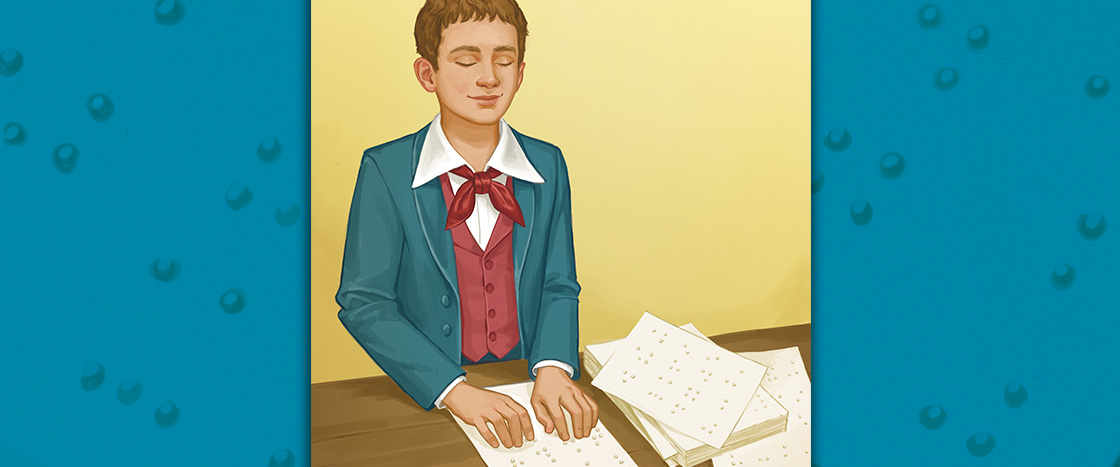

A boy sits at a desk and reads a braille book with his eyes closed and fingertips on the page
We would like to thank the National Federation of the Blind for its help with this article.

The Code That Changed the World

Louis Braille wanted to help blind people read. Would his idea work?

By Laine Falk
From the September 2026 Issue

LEARNING OBJECTIVE: Students will explore vocabulary words in a nonfiction text.

Lexile® measure: 560L
Featured Skill: Vocabulary

Standards

Download and Print

Art by Kelley McMorris
 

In 1816, a 7-year-old boy sat in school. His name was Louis Braille (LOO-ee brayl). 

The teacher pointed to words on a chalkboard. All the students read the words aloud except Louis. That’s because he was blind. He couldn’t see the words. 

Louis loved to learn. He wanted to participate. Would there ever be a way for blind students to read?

In 1816, Louis Braille (LOO-ee brayl) was 7 years old. He was at school.

The teacher pointed to words on a chalkboard. Students read the words aloud. But Louis did not. He couldn’t see the words. He was blind. 

Louis loved to learn and he wanted to read. Would there ever be a way for blind students to read?



Louis as a Child

Louis as a Child

Jim McMahon/Mapman ®
 

Louis was born in 1809 in a town in France. He wasn’t born blind.

When he was 3 years old, he had an accident in his father’s workshop. He jammed a sharp tool into his eye. The injury was bad. Louis became blind. 

A few years later, Louis’s parents wanted to send him to a school in France for blind children. There, he could learn things that he could not learn at his town school. But it was far away. Louis would have to leave his family and live at the school. 

He decided to go. He left home when he was just 10 years old. He would miss his family, but this was his big chance to learn. 

Louis was born in 1809. His family lived in a town in France. He wasn’t born blind.

He had an accident when he was 3 years old. He was in his father’s workshop. He stuck a sharp tool into his eye. The injury was bad. Louis became blind.

A few years later, Louis’s parents wanted to send him to a special school in France. It was for blind children. There, he could learn things that he could not learn at his town school. But it was far away. Louis would have to leave his family. He had to live at the school.

He decided to go. He left when he was 10 years old. He would miss his family. This was his big chance to learn.


At School

At School

Alamy Stock Photo

Louis was a student at this school for the blind in Paris, France. 

Louis made a best friend, Gabriel. Louis loved field trips to the city gardens. He excelled at school. He won prizes in history and math. He played the piano. 

When Louis was about 12 years old, a man came to the school. He had a new kind of writing called “night writing.” He thought it could help blind students to read. 

It was a code of dots that you could feel. Different groups of dots matched different sounds. 

Reading night writing took a long time. It was hard to match sounds with letters. There were no dots for punctuation, like periods or commas. There were no dots for numbers either. 

Louis thought he could invent something better.

Louis made a best friend, Gabriel. Louis loved field trips. They went to the city gardens. He excelled at school. He won prizes in history and math. He played the piano.

When Louis was about 12 years old, a man came to the school. He had a new kind of writing. It was called “night writing.” He thought it could help blind students to read.

It was a code. Different groups of dots matched different sounds. The dots were raised. You could feel them. 

Reading night writing took a long time. It was hard to match sounds with letters. There were no dots for punctuation, like periods or commas. There were no dots for numbers either.

Louis thought he could invent something better.


iStockPhoto/Getty Images

This person reads by feeling the raised dots.  

A New Way of Writing

A New Way of Writing

Sarin Images/The Granger Collection

Louis Braille

Louis started working on a new code. He also used raised dots that you could feel. But in his code, the dots stood for letters, not sounds. His code had dots for punctuation and numbers. 

He worked on his code for three years. He worked in the evenings, on weekends, and on summer vacations with his family. He was determined. He did not give up.

By the age of 15, Louis had done it! He had invented a new kind of writing for the blind. 

Louis brought it to the head of the school, Dr. Pignier (PEEN-yay). Dr. Pignier shared it with the students. They loved it! They could read so much faster than before. 

Dr. Pignier took it to the government of France. Wouldn’t it be great if this new way of writing could be used for everyone who was blind? But the government said no. It didn’t want to make the change. 

Meanwhile, Louis kept learning. He grew up to be a teacher at the school. 

He kept improving his code. He kept making it better. He shared it with others. Over time, people gave his code a name. They called it braille. 

Louis started working on a new code. He also used raised dots that you could feel. But in his code, the dots did not match sounds. They matched letters. His code had dots for punctuation. There were dots for numbers.

Louis worked on his code for three years. He worked in the evenings and on weekends. He even worked on it during summer vacations with his family. He was determined. He did not give up.

By the age of 15, Louis had done it! He had invented a new kind of writing.

Louis brought it to the head of the school. His name was Dr. Pignier (PEEN-yay). Dr. Pignier shared it with the students. They loved it! They could read so much faster.

Dr. Pignier took it to the government of France. He thought the new way of writing would be great for everyone who was blind. But the government said no. It didn’t want to make the change.

Louis kept learning. He grew up to be a teacher at the school.

He kept making his code better. He shared it with others. People even gave his code a name. They called it braille.


Shutterstock.com

Louis Braille’s alphabet is made of raised dots. 

Braille in the World

Braille in the World

Joerg Boethling/Alamy Stock Photo

Millions of people around the world read braille!

Louis died at the age of 43 in 1852. His code was not yet famous. 

But 20 years after he died, people met in Paris, France, to talk about it. At last, they chose braille as the main way of writing for the blind. 

Over time, Louis did become famous. One hundred years after he died, France honored him with a big celebration. His childhood home became a museum! 

Today you can find braille on elevators and museum signs. Hundreds of children’s books are available in braille. And millions of people around the world get the chance to read, thanks to Louis Braille and his code.

In 1852, Louis died. He was 43 years old. His code was not yet famous.

But 20 years after he died, people met in Paris, France. They talked about braille. They chose braille as the main way of writing for the blind.

Over time, Louis did become famous. One hundred years after he died, France honored him with a big celebration. His childhood home became a museum!

Today you can find braille on elevators and museum signs. Hundreds of children’s books are in braille. And millions of people around the world get the chance to read, thanks to Louis Braille and his code. 


video (1)
Slideshows (1)
Activities (3) Download All Quizzes and Activities
Answer Key (1)
Text-to-Speech