


Article
USGS

Journey Inside a Volcano

Travel inside one of the most active volcanoes in the world! 

By Tricia Culligan
From the March / April 2026 Issue

Learning Objective: Students will determine the meaning of words and phrases in a text about volcanoes.

Lexile® measure: 570L
Featured Skill: Vocabulary

Standards

Download and Print
Think and Read

As you read, look for new words and clues about what they mean. 

USGS
 

Jim McMahon/Mapman ® (Globe)
 

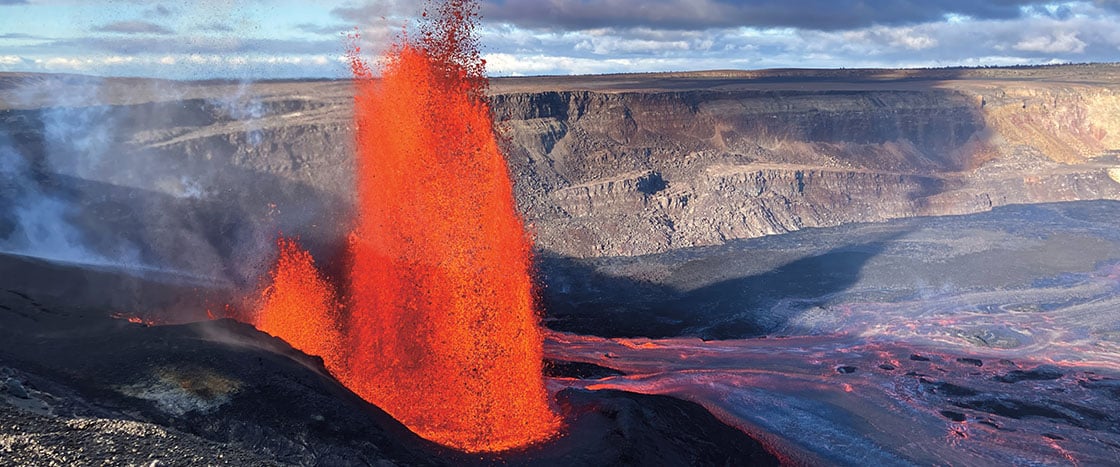
It’s a sunny day in Hawaii. Palm trees sway in the breeze. Waves crash on the beach in the distance. But instead of sinking your toes into the sand, you watch melted, red-hot rock flow by your boots. It’s lava!

You’re standing on the edge of something incredibly powerful. It’s a volcano. And this isn’t just any volcano. This is Kilauea (kee-lah-WAY-ah), one of the most active volcanoes on the planet.

What are you doing here? You’re a volcanologist, a scientist who studies volcanoes. You travel the world trying to figure out when a volcano will become dangerous.

Lava usually flows gently out of Kilauea. But in 2018, the volcano erupted dangerously. Lava came pouring out. Could this happen again? That’s what you’re trying to figure out. How will you do it? You’ll go into the volcano!

It’s a sunny day in Hawaii. You see palm trees. They are swaying in the breeze. You hear waves crashing on the beach. But you are not sinking your toes into the sand. You are watching melted, red-hot rock move by your boots. It’s lava!

You’re standing on the edge of a volcano. This isn’t just any volcano. This is Kilauea (kee-lah-WAY-ah), one of the most It’s a sunny day in Hawaii. You see palm trees. They are swaying in the breeze. You hear waves crashing on the beach. But you are not sinking your toes into the sand. You are watching melted, red-hot rock move by your boots. It’s lava!

You’re standing on the edge of a volcano. This isn’t just any volcano. This is Kilauea (kee-lah-WAY-ah), one of the most active volcanoes on the planet.

What are you doing here? You are a scientist who studies volcanoes. You are called a volcanologist. You travel all over the world trying to figure out when a volcano will become dangerous.

Lava usually flows gently out of Kilauea. But in 2018 that changed. The volcano erupted dangerously. Lava came pouring out. Could this happen again? That’s what you’re trying to figure out. How will you do it? You’ll go into the volcano! volcanoes on the planet.

What are you doing here? You are a scientist who studies volcanoes. You are called a volcanologist. You travel all over the world trying to figure out when a volcano will become dangerous.

Lava usually flows gently out of Kilauea. But in 2018 that changed. The volcano erupted dangerously. Lava came pouring out. Could this happen again? That’s what you’re trying to figure out. How will you do it? You’ll go into the volcano!



Into the Volcano

Into the Volcano

subhed

KRAFFT/EXPLORER/SCIENCE SOURCE

Volcanologists often wear heatproof suits when they study volcanoes.

Volcanologists have an important job. If you can predict when a volcano will erupt, you can let people know about it. Then they can leave the area in time and stay safe. It’s an exciting, dangerous job, and you love it!

Ahead you see a large, hollow opening called a crater. You put on a heatproof suit and climb down the crater’s wall. Your suit keeps you safe in the heat.

Right away, you’re hit with a scent so powerful, it stings your nose. It smells like rotten eggs. But it’s gas rising from the volcano.

At the bottom of the crater, you see dusty rocks everywhere. The air is hot and dry. Fiery magma is flowing right beneath the rocks you’re standing on. Magma is what we call lava while it’s underground. It’s time to find out if this magma is about to explode!

You get to work. You start collecting rocks. You take measurements. You’re like a detective searching for clues. You write down notes about what you see, hear, and feel.

When volcanoes are ready to burst open, they get bigger. Magma pushes the rocks out. That changes the volcano’s shape. What is another sign the volcano might explode? Earthquakes happen. You check for big cracks in the rocks or any shaking in the ground.

Suddenly, a whirlwind of dust fills the air. It’s hard to see. Time to get out of here!

Volcanologists have an important job. They try to predict when a volcano will erupt. People can then know when to leave. They can stay safe. It’s an exciting and dangerous job. You love it!

Ahead you see a crater. It is a large and hollow opening. You put on a heatproof suit to keep you safe from the heat. Then you climb down the crater’s wall.

Right away, your nose starts to sting. You smell something terrible. It smells like rotten eggs. But it’s gas rising from the volcano.

At the bottom of the crater, you see dusty rocks everywhere. The air is hot and dry. Fiery magma is flowing right under the rocks you’re standing on. Magma is what we call lava while it’s underground. It’s time to find out if this magma is about to explode!

You get to work. You start collecting rocks. You take measurements. You search for clues.

You write down notes about what you see, hear, and feel.

Volcanoes get bigger when they are ready to burst open. Magma pushes the rocks out. The volcano changes shape. Earthquakes are another sign that the volcano might explode. You check for big cracks in the rocks or any shaking in the ground.

Suddenly, a cloud of dust fills the air. It’s hard to see. Time to get out of here!


ILLUSTRATION BY KATE FRANCIS

Clockwise from lower left:

1. It is so hot deep inside Earth that rock melts. Melted rock is called magma.

2. The magma is pushed toward openings called vents.

3. Magma erupts through the vents. When magma comes out, it is called lava.

4. The lava flows down the sides of the volcano. It cools and hardens, making the volcano bigger.

Outside the Volcano

Outside the Volcano

LIZZIE RENAUD

Nosey says: "I lava how volcanologists help people."

Back outside, you see a lava stream. Click! You snap some pictures. You scoop up a sample of lava with a shovel. As the lava flows, it gets stiff and heavy. You use a metal hook to yank out some more. Later you’ll study what you gathered in a lab.

Right now, you don’t see any signs of danger. Eruptions can be hard to predict though. Nobody knows exactly when Kilauea will have another dangerous explosion.

That’s why your job is so important. You’ll keep watching. You’ll be ready to warn people before the volcano goes BOOM!

Back outside, you see a lava stream. You take some pictures. You pick up a sample of lava with a shovel. The lava gets stiff and heavy as it flows. You use a metal hook to tug out some more. Later you’ll study what you picked up in a lab.

Right now, you don’t see any signs of danger. It can be hard to predict an eruption. Nobody knows exactly when Kilauea will have another dangerous explosion.

That’s why your job is so important. You’ll keep watching. You’ll be ready to warn people before the volcano goes BOOM!


USGS

A scientist scoops lava with a shovel.

Volcano Mode

Volcano Mode

What comes from volcanoes?

What comes from volcanoes?

ISTOCKPHOTO/GETTY IMAGES (TOOL); SHUTTERSTOCK.COM (NECKLACE, OBSIDIAN)

Shiny, Black Rocks

This black rock is called obsidian. It forms when lava cools quickly. People use it to make tools and art. Does it look like the cooling lava above?

Pictured from left: obsidian, necklace, tool

Shiny, Black Rocks

This black rock is called obsidian. It forms when lava cools quickly. People use it to make tools and art. Does it look like the cooling lava above?

Pictured from left: obsidian, necklace, tool

SHUTTERSTOCK.COM
 

Crops to Eat

Volcanic soil has a lot of ash in it. Farmers use soil from volcanoes on their farms. Crops like bananas grow well in ashy soil.

Crops to Eat

Volcanic soil has a lot of ash in it. Farmers use soil from volcanoes on their farms. Crops like bananas grow well in ashy soil.

SHUTTERSTOCK.COM 
 

Rocks for Rubbing

This rock is made of lava. It is called pumice. It has air pockets in it that make it light and rough. People rub it on their feet to make them smoother.

Rocks for Rubbing

This rock is made of lava. It is called pumice. It has air pockets in it that make it light and rough. People rub it on their feet to make them smoother.

JOHAN ORDONEZ/AFP via Getty Images

Pizzas?!

Some volcanoes are hot but are not dangerous to people. This man set up a pizza shop on a volcano! He cooks pizza on the hot rocks and sells slices.

Pizzas?!

Some volcanoes are hot but are not dangerous to people. This man set up a pizza shop on a volcano! He cooks pizza on the hot rocks and sells slices.

video (1)
Slideshows (1)
Activities (3)
Answer Key (1)
video (1)
Slideshows (1)
Activities (3) Download All Quizzes and Activities
Answer Key (1)
Text-to-Speech